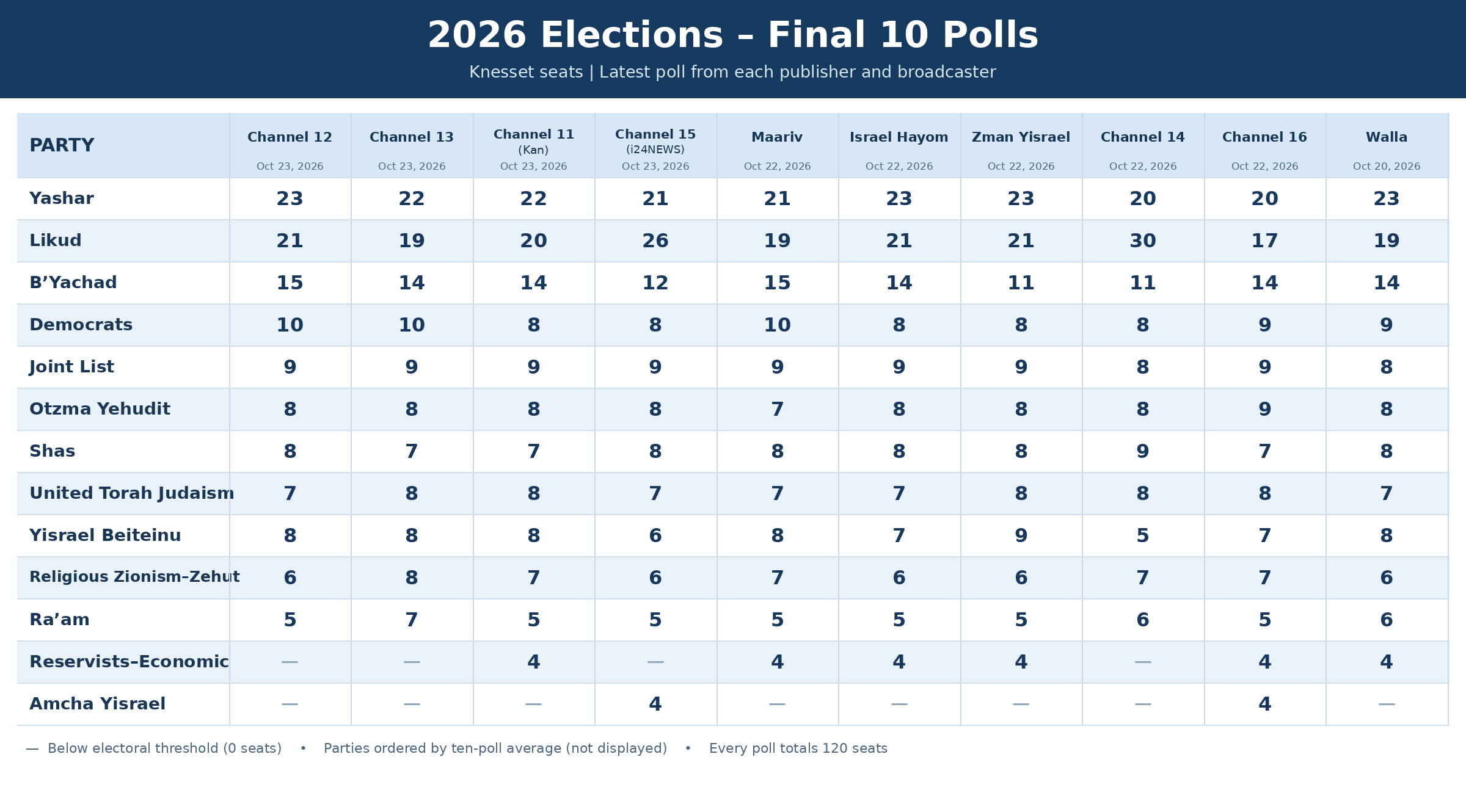
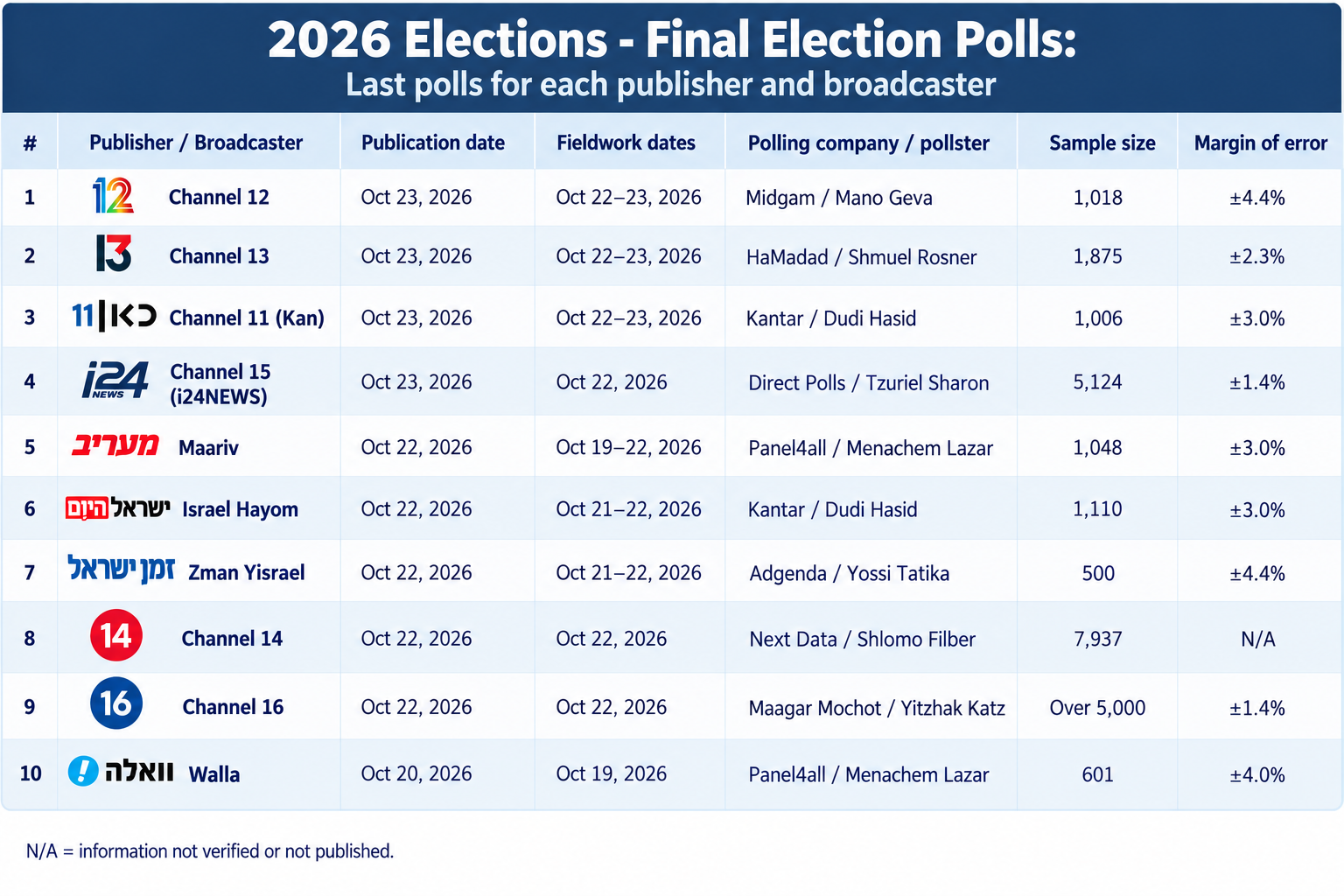
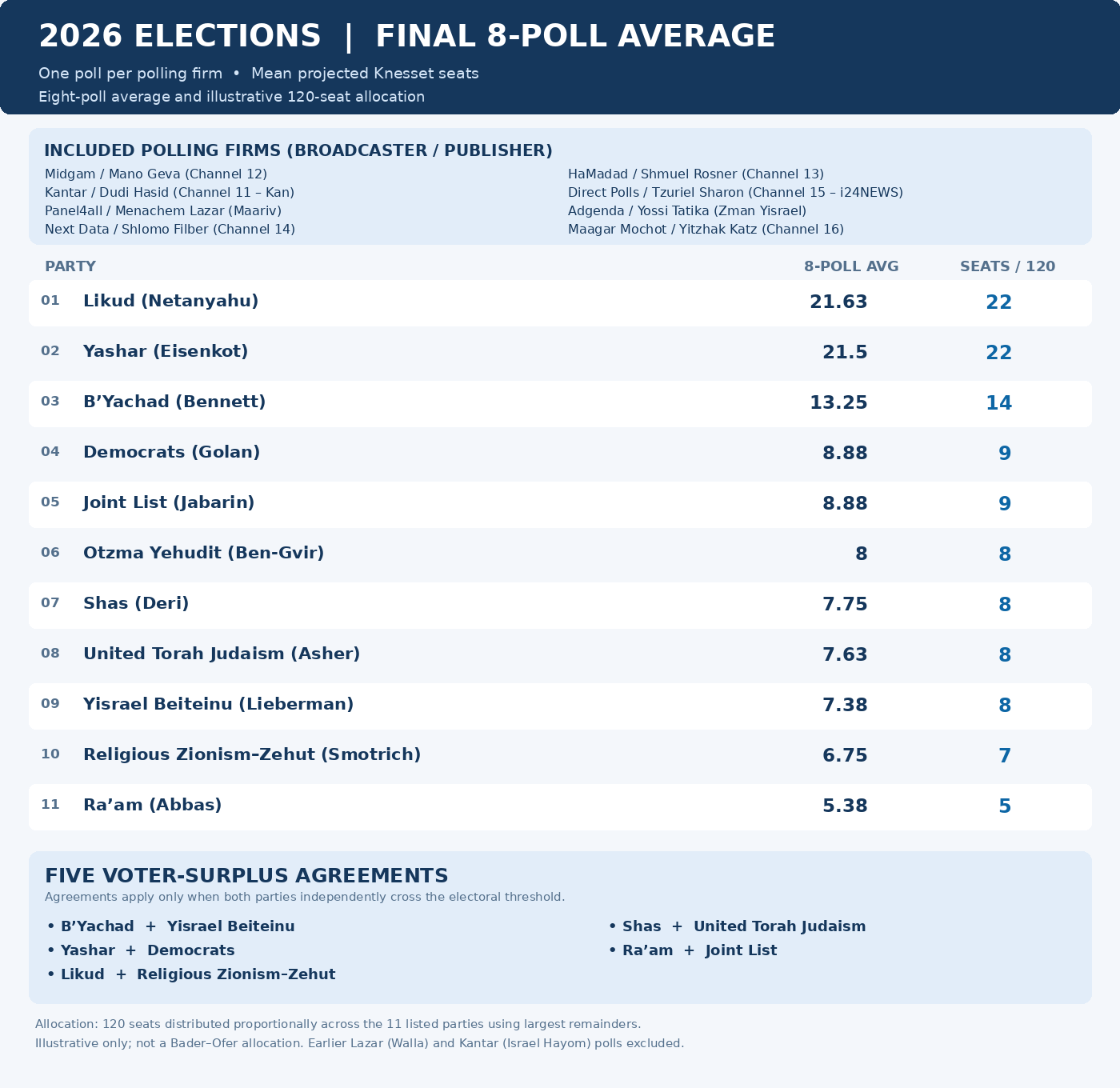
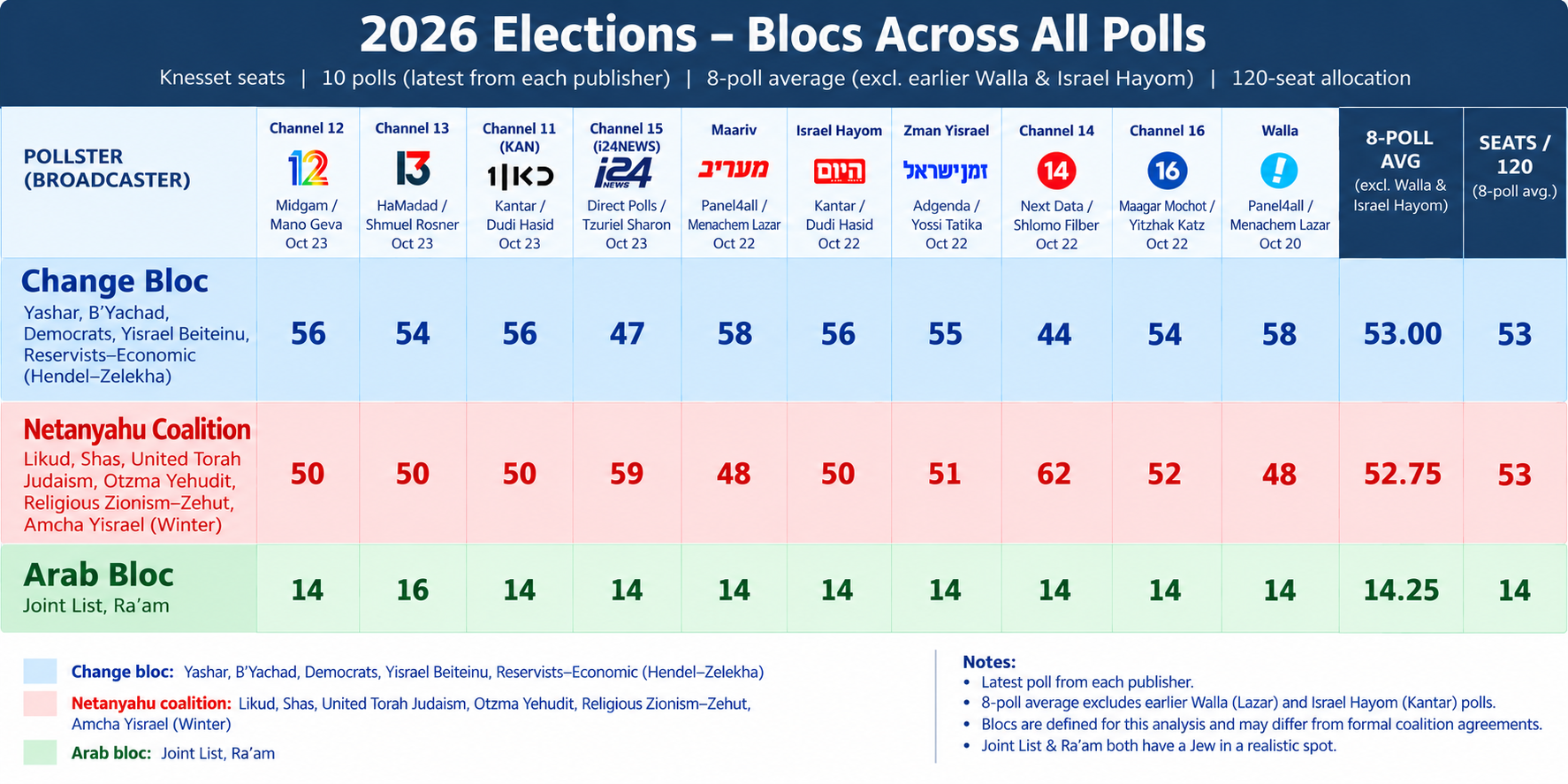
Election Timing: The next election is still scheduled for October 27, 2026, just 131 days away. Unless the Knesset votes to disperse earlier before the end of the summer session in late July, that remains the date on which Israelis will choose the 27th Knesset.
Core takeaways: Netanyahu remains blocked in most polls and Bennett the clear opposition favorite.
While Netanyahu leads all head-to-head matchups, he is within the margin of error against Bennett (40–37), who remains competitive. At the same time, large pools of undecided voters signal continued volatility, particularly voters considering Gadi Eisenkot, whose potential support appears broad but shallow. Bennett is also the clear favorite to lead the non-Netanyahu Bloc, 37% to 28% for Eisenkot in the multi candidate poll and 51%-35% in the head-to-head matchup.
Public opinion remains sharply polarized: Torch lighting ceremony: ~45% view it as political vs ~31% statesmanlike Inquiry committee: 60% favor a state commission vs 23% a government-appointed one Across both issues, there is a clear divide between coalition and opposition voters.
Bloc Trends & Eyes on the Threshold
The dominant structural factor remains the ~6–8% wasted vote from parties below the threshold, enough to materially shift bloc outcomes.
For the Netanyahu bloc: The central vulnerability is Bezalel Smotrich running alone, failing to pass the threshold in most polls outside Filber, Additional risks include potential independent runs by Avi Maoz (Noam) and a new party led by Ofer Winter. For the Bennett bloc: Vote leakage to Benny Gantz and Yoaz Hendel, both consistently below threshold. For the Arab bloc: Fragmentation risk if Sami Abu Shehadeh leads Balad in an independent run.
Threshold dynamics alone explain much of the gap between polls, particularly the divergence seen in Filber where Smotrich consistently passes and the others do not.
What to Watch Next
We are roughly six months out from the election, and the system remains structurally locked: Bennett bloc ~60 and the Netanyahu bloc short of 61 in most polls.
Key upcoming trigger point: The Knesset returns from recess on May 11 From there, two scenarios: Status quo timeline: Knesset session runs through late July → election recess → 27 October election. Early election scenario: Government falls in May → election window between August 11 – September 1.
Bottom Line: The map has not fundamentally shifted with Netanyahu still blocked and Bennett consolidating the support within his camp.
Poll
Publisher
Pollster
Date
Sample
Margin of Error
1
Maariv
Lazar
April 23, 2026
502
±4.4%
2
Channel 12
Midgam
April 23, 2026
502
±4.4%
3
Channel 14
Filber
April 23, 2026
958
N/A
Party
Maariv/Lazar
Channel 12/Midgam
Channel 14/Filber
Likud (Netanyahu)
24
25
35
Bennett 2026 (Bennett)
24
21
10
Yashar (Eisenkot)
12
14
12
Democrats (Golan)
9
10
8
Yisrael Beteinu (Lieberman)
9
8
9
Yesh Atid (Lapid)
7
7
4
Shas (Deri)
9
9
11
UTJ
7
7
8
Otzma Yehudit (Ben Gvir)
9
9
8
Religious Zionist Party (Smotrich)
2.8%
2.7%
4
Joint List (Arab Bloc)
—
—
11
Hadash-Ta’al (Arab Bloc)
5
5
—
Ra’an (Arab Bloc)
5
5
—
Balad (Arab Bloc)
1.4%
0.4%
—
Reservists (Hendel)
2%
1.3%
—
Blue & White (Gantz)
1.7%
0.8%
1.2%
Bloc
Maariv/Lazar
Channel 12/Midgam
Channel 14/Filber
Netanyahu Bloc
49
50
66
Bennett Bloc
61
60
43
Arab Bloc
10
10
11
Additional Polls: All polls from Midgam unless specifically written
Matchup
Netanyahu
Opponent
Don’t Know
vs Bennett
40%
37%
23%
vs Eisenkot
40%
35%
25%
vs Lapid
44%
24%
32%
vs Lieberman
42%
19%
39%
Candidate to Lead the Non-Netanyahu Bloc
%
Bennett
37%
Eisenkot
29%
Lapid
12%
Lieberman
8%
Golan
6%
Don’t Know
8%
Bennett vs Eisenkot (Among Bloc Voters)
%
Bennett
51%
Eisenkot
35%
Don’t Know
14%
Commission of Inquiry Preference
General Public
Coalition Voters
Opposition Voters
State Commission (appointed by Supreme Court President)
While I typically focus on polling, this post examines current market-implied probabilities on Polymarket. For context, Polymarket is a decentralized prediction market where participants trade on real-world outcomes, with prices reflecting collective expectations.
Analysis:
Netanyahu has not crossed 50% since March 16. For an incumbent, remaining below that threshold ahead of any head-to-head consolidation is a notable constraint.
Momentum in the challenger field is shifting. Just two days ago, Bennett stood at 27% and Eisenkot at 18.9%; Bennett has since climbed to 32%, while Eisenkot has declined to 16.9%. The net effect is a clearer consolidation of second place.
Gideon Sa’ar, now aligned with Likud, has edged into fourth place at 2%. This is less a surge than a reflection of the broader field fading. Lapid has not exceeded 5% since December 9; Gantz has never reached 5%; and Lieberman has never crossed 4%.
Notably, Yair Golan sits in 11th place, behind senior ministers Yariv Levin, Israel Katz, and Itamar Ben-Gvir.
Why it matters:
Prediction markets aim to aggregate dispersed information into a single price signal. In volatile political environments, especially in the Middle East, this can offer a real-time, probabilistic read that complements, and sometimes challenges, traditional polling and media narratives.
Polymarket Question: “Who will be the next Prime Minister of Israel after the next election?”
Market Mechanics: Open date: November 14, 2025 (7:21 PM ET) Scheduled election: October 27, 2026 Resolution: The market resolves to the individual officially appointed and sworn in as Prime Minister following the election. Early election clause: If elections are called early, resolution follows the next sworn-in Prime Minister after that vote. Requirement: Formal swearing-in is necessary for resolution. Caretaker PMs: Do not count. Deadline: If no PM is sworn in by December 31, 2027, the market resolves to “Other.” Sources: Official Government of Israel information, supplemented by consensus credible reporting if needed.
Five new polls this week show a race that is simultaneously consolidating and fragmenting. The top of the map is stabilizing. The blocs are not.
The prime ministerial matchup remains binary. Across multiple surveys, the race has consolidated into a Netanyahu vs Bennett frame, with Channel 14 uniquely framing an internal Bennett vs Eisenkot dynamic. Everywhere else, Bennett consistently performs best in direct matchups, while Netanyahu continues to lead comfortably against Eisenkot, Lapid and Lieberman. The anti-Netanyahu Lane is narrowing. The consolidation is real.
The economic mood is soft. In the Zman Yisrael poll, 42% say their economic situation has worsened compared to 20% who say it improved. That is a net negative environment heading into a budget deadline month, particularly for a government advancing economic reforms late in its term.
On the October 7 law, there is rare cross-bloc consensus. In the i24 poll, 84% oppose removing the word “massacre” from the legislation, including 73% of coalition voters. In a polarized system, that level of cross-camp alignment stands out.
Bloc Trends
The bloc map remains competitive but structurally fragile. The Bennett bloc ranges from 56–60 seats in three polls and collapses to 42 in the two Netanyahu-leaning surveys (i24 and Channel 14). The Netanyahu bloc ranges from 49–53 in most surveys and surges to 64–65 in i24 and Channel 14.
This divergence is not typical statistical noise. It reflects turnout assumptions, Arab party configuration, and threshold modeling. Small shifts in participation or list alignment generate dramatically different outcomes.
Eyes on the Threshold
The most volatile variable remains the small parties. Several lists consistently hover at or below the 3.25% threshold. The seat math changes dramatically depending on whether one or two of these lists clear the barrier. A single party failing to pass can swing the bloc map by 4–6 seats instantly. The system is currently within margin-of-error distance of multiple wasted-seat scenarios.
What to Watch Next
The budget deadline is looming. The House Committee has decided there will be no plenum next week due to Purim, compressing an already tight legislative calendar. Failure to pass the 2026 budget by April 1 automatically triggers elections on June 30. The draft law remains the hinge issue for Shas and UTJ support. As we enter the decisive month, both the coalition draft bill and the state budget must move through the system simultaneously.
Even if political agreement is reached internally, the inability to manage the legislative clock could independently trigger an election. The countdown, not the polls, remains the dominant variable.
At the same time, opposition leadership consolidation bears watching. In Channel 12, Bennett leads the question of who should head the opposition bloc at 42%, compared to 19% for Eisenkot. If that gap widens, the consolidation dynamic accelerates.
The coalition’s survival still depends more on internal legislative math than public polling, but the electoral battlefield is increasingly defined.
Israeli Political System at a Decision Point: 38 Days Until the 2026 Budget Deadline
If the coalition fails to pass the 2026 State Budget by April 1, Israeli law triggers an automatic election on June 30, four months earlier than scheduled. With 38 days remaining, polling data and coalition math now intersect directly with legislative survival.
Issue Trends
Budget Deadline and Coalition Constraints
The coalition’s immediate hurdle is the Haredi Draft Law. The legislation must pass with sufficient time before April 1 to secure the support of Shas and at least part of United Torah Judaism for the budget vote. If the draft bill passes, the budget likely passes. If the draft bill stalls, the budget becomes highly uncertain. The countdown is not symbolic. It is structural.
Leadership Consolidation
Across multiple polls, the prime ministerial matchup has consolidated into a two-person frame. Bennett remains the clear alternative to Netanyahu, with other opposition figures structurally squeezed out. The race operates within a binary structure.
Issue Environment
Two dominant voter patterns: Security: ~40% overall priority; over 50% among coalition voters. The Trust Gap: A persistent credibility deficit around October 7 framing. The trust gap is not collapsing the coalition, but it continues to cap its expansion potential.
Bloc Trends
The bloc map is stable, but competitive. Across five recent polls: The Bennett-aligned bloc is in the mid-to-high 50s, peaking at 60. The Netanyahu bloc is 50–52 in four polls. The outlier is Filber with 65.
The structural battleground centers on three variables: Turnout asymmetry. Arab party configuration (unified vs. split). Threshold survival or mergers among smaller lists. Small shifts in any of these variables could reverse the bloc advantage.
Eyes on the Threshold
Several parties consistently poll below the 3.25% electoral threshold. If one party crosses, it could shift 3–5 seats between blocs. If multiple parties fail, wasted votes could reshape the entire map, as seen in 2022. In this environment, survival is not marginal. It is determinative.
What to Watch Next
The primary development outside the Knesset shaping the next 38 days is narrative dominance. Which frame defines the campaign? Security, Cost of Living, Leadership fatigue. Security currently leads, but compressed timelines amplify volatility.
The clock is legislative. The polls are structural. The next month determines whether this becomes a budget crisis or an election campaign.