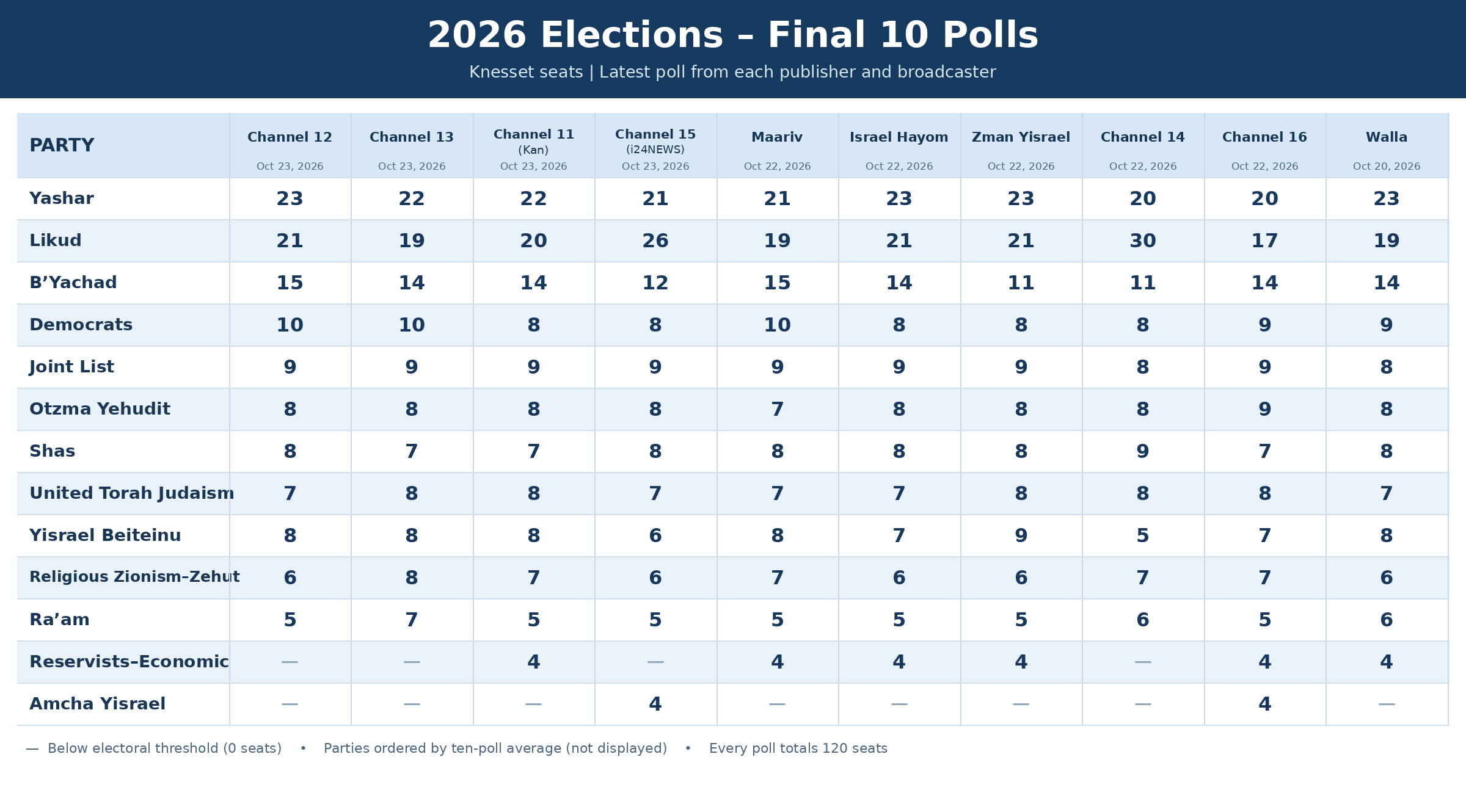
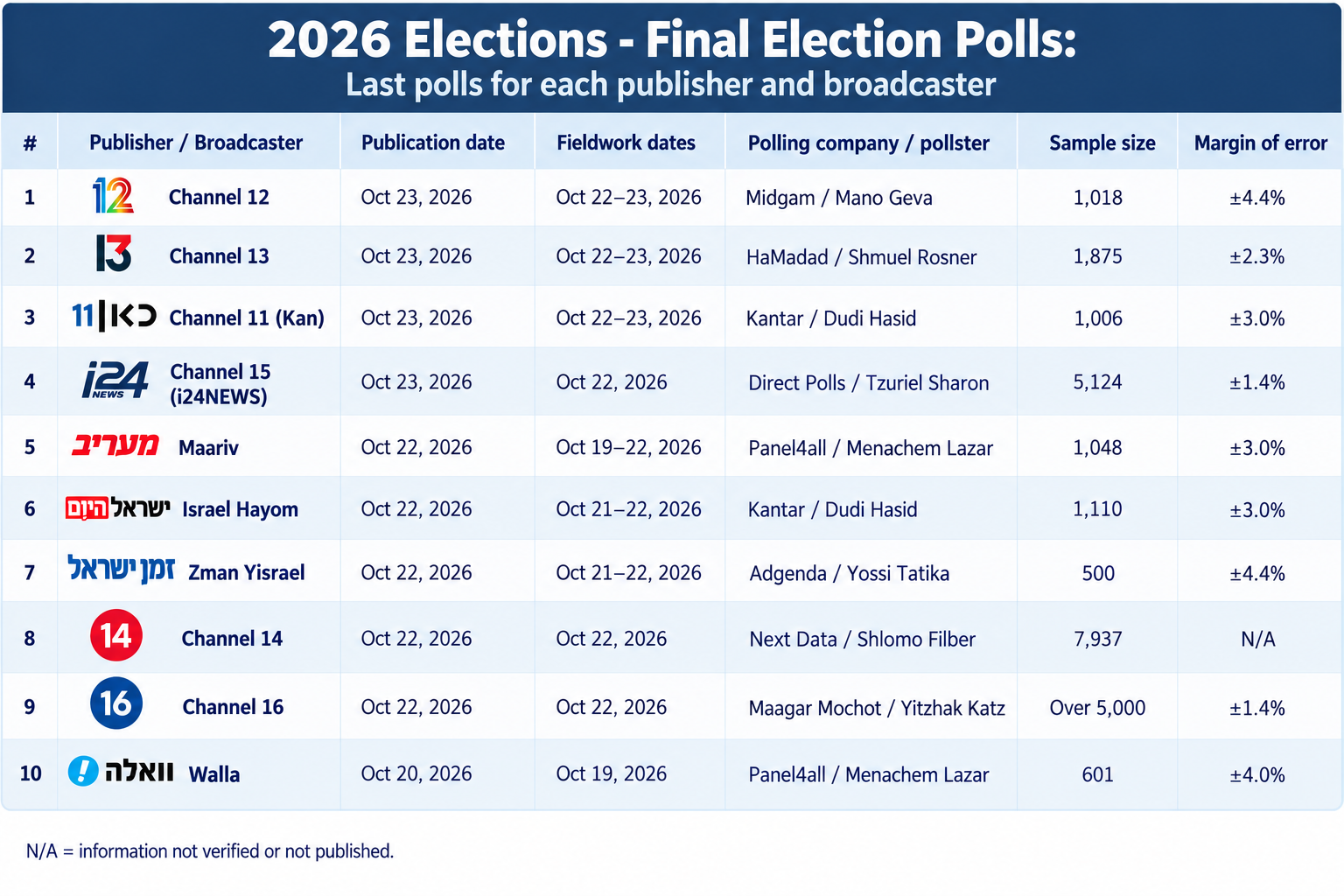
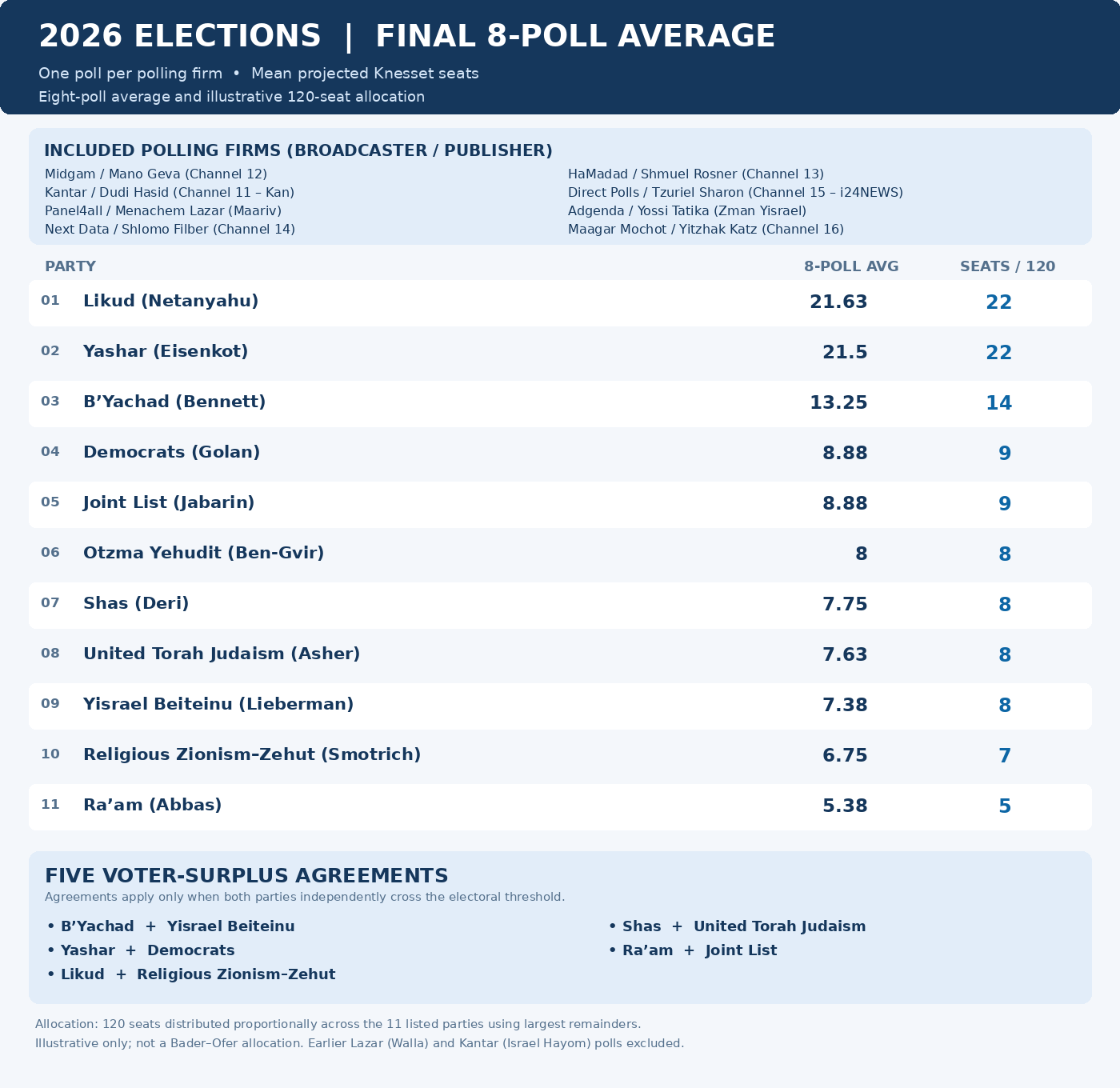
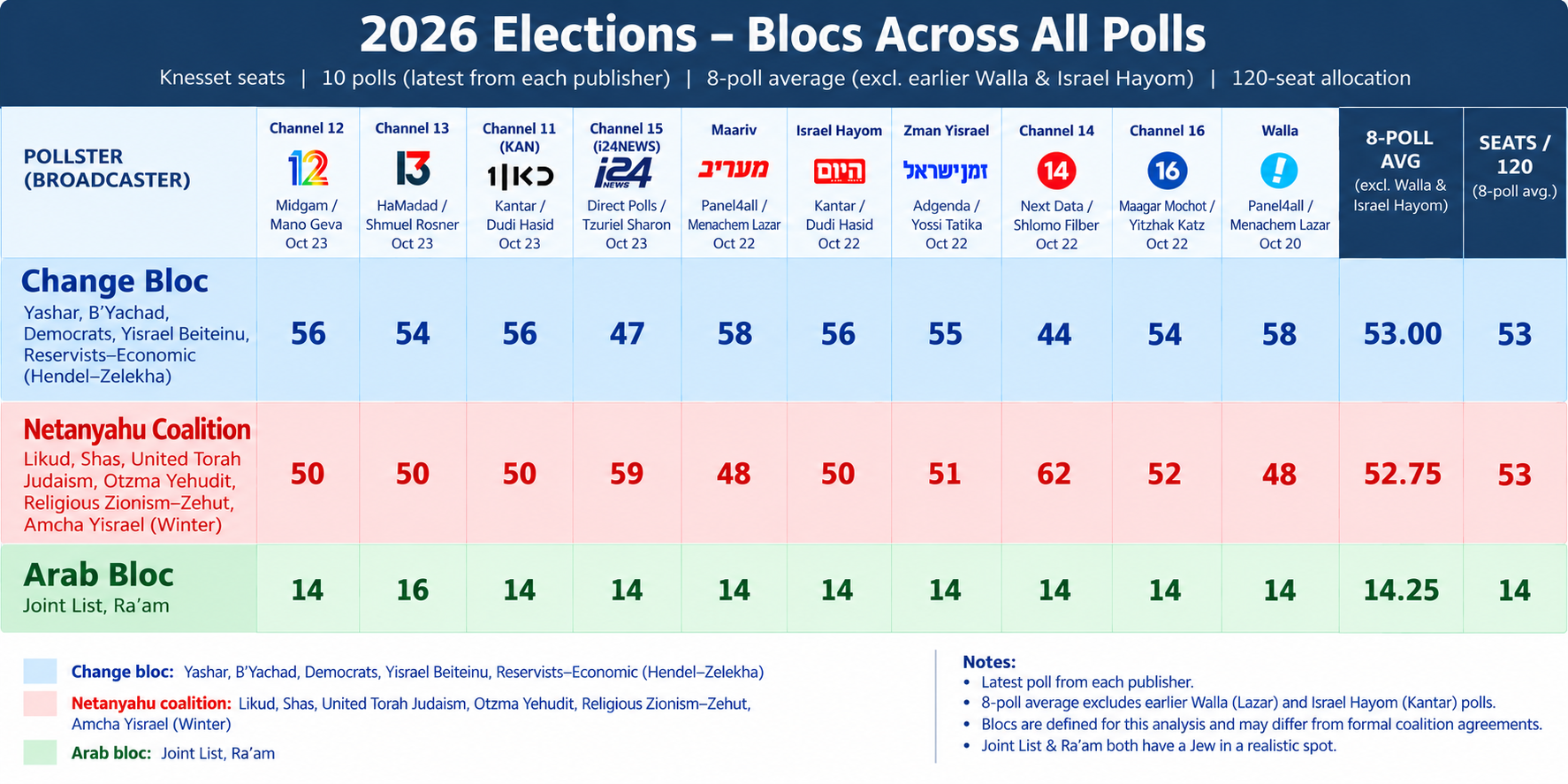
Latest Entries »

Issue Trends

Across all five polls, Bennett emerges as the clear alternative in the prime minister matchup landscape. In every head-to-head pairing tested, whether against Netanyahu alone or in multi-candidate suitability questions, Bennett consistently places second and well ahead of other opposition figures. Against Netanyahu, he is competitive in direct matchups (often within single digits), and in broader “who is most suitable” questions he is the only opposition figure consolidating meaningful support. No other contender consistently clears the low-to-mid 30s.

At the same time, public distrust surrounding October 7 remains structurally significant. Majorities or pluralities in multiple polls say they do not believe Netanyahu’s version of events leading to October 7. Separate questions about documents submitted to the State Comptroller show similar skepticism. On responsibility, large majorities assign blame to senior security officials, but 63% in one poll also assign responsibility to Netanyahu himself.

On the draft law, a majority (52% in Channel 12) believe its primary purpose is preserving the government rather than drafting Haredim, a politically sensitive finding given the coalition arithmetic.

Among Religious Zionist voters specifically, Smotrich’s party is split evenly: 46% say it represents them; 46% say it does not. That is not consolidation, it is fragmentation.

Taken together: Bennett consolidates the alternative lane, while trust deficits and governance questions remain live issues for the prime minister.

Bloc Trends

The Bennett Bloc remains ahead in most polls. The key variable is Arab party configuration. When Arab parties are modeled as unified, the Arab Bloc reaches double digits and reshapes the math. Bloc totals show the difference between when the parties are united vs separate. When modeled separately, totals shift, tightening the race. Across four of five polls, however, the Bennett-aligned bloc clusters above the Netanyahu Bloc. Only one poll (Filber) shows a decisive Netanyahu Bloc advantage.

Eyes on the Threshold

Threshold volatility remains one of the most consequential moving parts in the bloc math. In the week of Hendel’s party primaries, the party failed to cross the electoral threshold in every poll. Equally notable: the party did not publicly release how many members registered to participate in the primaries, a data point typically used to signal momentum. The absence of both polling viability and organizational transparency raises real questions about its viability.

What to Expect Next

The deadline to pass the state budget is now 46 days away. If the budget is not approved, Israeli law mandates an automatic election for June 30. That ticking clock now overlays the polling environment. Any instability within the coalition, particularly around the draft law or budget committee meetings, could move from theoretical to procedural very quickly. The next six weeks will determine whether this remains a polling story or becomes an election calendar story.

Poll #Broadcaster / PublisherPollsterDatesSample SizeMargin of Error
1MaarivLazar / PanelsFeb 11–12, 20265934%
2Channel 12 MidgamFeb 12, 20265084.4%
3Israel HayomKantarFeb 11, 20266054%
4Zman IsraelTatikaFeb 11–12, 20265004.4%
5Channel 14FilberFeb 12, 2026532Not Reported
PartyMaarivChannel 12Yisrael HayomZman YisraelChannel 14
Likud (Netanyahu)2525262735
Bennett 20262120201910
Joint List10 (5+5+2%)12131513
Yashar (Eisenkot)12111088
Democrats (Golan)9119810
Yisrael Beitenu (Lieberman)999108
Shas (Deri)8991010
Otzma Yehudit (Ben Gvir)1091077
Yesh Atid (Lapid)97785
United Torah Judaism77789
Religious Zionism (Smotrich)2.5%2.7%2.7%05
Blue & White (Gantz)2.5%1.9%2.9%02.5%
Miluimnikim (Hendel)2.3%2.0%1.9%0
Bennett Bloc6058 / 5955 / 5753 / 5641
Netanyahu Bloc5050 / 5152 / 5352 / 5366
Arab Bloc1012 / 1013 / 1015 / 1113
PollQuestionResults
MaarivNetanyahu vs BennettNetanyahu 41%, Bennett 40%, Don’t Know 19%
MaarivNetanyahu vs EisenkotNetanyahu 42%, Eisenkot 38%, Don’t Know 20%
MaarivNetanyahu vs LiebermanNetanyahu 46%, Lieberman 30%, Don’t Know 24%
MaarivNetanyahu vs LapidNetanyahu 47%, Lapid 30%, Don’t Know 23%
MaarivBelieve Netanyahu’s Version on Events Leading to Oct 7Do Not Believe 47%, Believe 28%, Don’t Know 25%
Channel 12Netanyahu vs BennettNetanyahu 38%, Bennett 35%, Neither 24%, Don’t Know 3%
Channel 12Netanyahu vs LiebermanNetanyahu 39%, Lieberman 22%, Neither 35%, Don’t Know 4%
Channel 12Netanyahu vs EisenkotNetanyahu 40%, Eisenkot 30%, Don’t Know 30%
Channel 12Netanyahu vs LapidNetanyahu 41%, Lapid 24%, Neither 33%, Don’t Know 2%
Channel 12Believe Opposition Claim Regarding Edited Oct 7 DocumentBelieve Opposition 47%, Believe Netanyahu 32%, Don’t Know 21%
Channel 12Purpose of Draft LawPreserve Government 52%, Draft Haredim 35%, Don’t Know 13%
Channel 12What Will Happen to Hamas?Not Disarmed 47%, Partially Disarmed 28%, Fully Disarmed 12%, Don’t Know 13%
Yisrael HayomConvinced by Netanyahu’s Explanation to State ComptrollerNot Convinced 59%, Convinced 27%, Don’t Know 14%
Yisrael HayomResponsibility for October 7Halevi 76%; Ronen Bar 75%; Barnea 60%; Gallant 68%; Netanyahu 63%
Yisrael HayomDoes Religious Zionism (Smotrich) Represent Religious Zionists?Yes 46%, No 46%, Don’t Know 8%
Zman YisraelBelieve Netanyahu’s Version on Pre–Oct 7 EventsDo Not Believe 51%, Believe 39%, Don’t Know 10%
Channel 14Suitability for Prime MinisterNetanyahu 57%, Bennett 19%, Eisenkot 13%, Lapid 5%, Lieberman 4%, Gantz 2%

Issue Trends

The most important development this week is not movement in seat distribution. It is the consolidation of the prime minister race.

In the Channel 12 poll, the head-to-head between Bennett and Netanyahu is a dead tie: 40%–40%, with 18% saying neither and 2% undecided. That is not statistical noise. It is the clearest crystallization yet of a two-person contest.

Netanyahu continues to lead comfortably against other alternatives: 41%–31% vs Eisenkot, 44%–23% vs Lapid, and 43%–22% vs Lieberman.

Channel 14’s suitability question reinforces the pattern. Netanyahu leads overall with 52%, but Bennett is the clear second at 20%, well ahead of Eisenkot (14%), Lapid (6%), Lieberman (6%), and Gantz (2%).

Across pollsters, the structure is consistent: Bennett consolidates the anti-Netanyahu lane while other opposition figures fragment it.

Netanyahu retains a firm personal base, but when the field narrows to one challenger, the race becomes competitive. Leadership questions behave differently from party-seat questions. In binary matchups, volatility shrinks and polarization sharpens. A 40–40 tie signals an electorate split almost exactly in half. That is far less stable than a 4–6 seat mandate gap.

Bloc Trends

Seat arithmetic remains competitive in five of the six polls. With the exception of Channel 14 (Filber), the Bennett Bloc consistently lands in the mid-to-high 50s, while the Netanyahu Bloc remains in the low 50s.

One structural nuance stands out: the Bennett Bloc performs better when Arab parties run separately rather than as a unified Joint List. I provided the bloc totals for both scenarios in the table below.

Eyes on the Threshold

One consistent pattern: Hendel fails to pass the threshold in every poll. He remains below 3.25% throughout, and his voters currently convert to zero mandates. For now, those votes remain structurally wasted.

What to Expect Next

The last time a Knesset completed its full term was 1988. We are roughly eight and a half months from the scheduled end of this term. Because early elections require approximately three months of procedural runway, we are entering a five-month window in which early elections can still realistically be called.

Beyond that, incentives shift. If the government passes the budget next month, the closer the system moves to automatic dissolution, the harder it becomes to justify triggering an early vote. Political actors will increasingly weigh whether collapse is worth it when the clock is already running. The calendar is narrowing. The strategic window is open, but not indefinitely.

Poll #Broadcaster / PublisherPollsterDateSample SizeMargin of Error
1Channel 12Midgam5 Feb 2026500±4.4%
2MaarivLazar / Panels4–5 Feb 2026501±4.4%
3Channel 13Maagar Mochot4 Feb 2026651±3.8%
4Zman YisraelTatka 4–5 Feb 2026500±4.4%
5Channel 14Filber5 Feb 2026952Not Published
6Yisrael HayomTrendZone5 Feb 2026Not PublishedNot Published
Party / BlocChannel 12MaarivChannel 13Zman YisraelChannel 14
Likud (Netanyahu)2625262734
Bennett 20262323221811
Joint List1212151413
Shas (Deri)9791011
Democrats (Golan)1010889
Yisrael Beitenu (Lieberman)887108
Yashar (Eisenkot)109666
Otzma Yehudit (Ben Gvir)88977
UTJ77689
Yesh Atid (Lapid)77884
Religious Zionism (Smotrich)1.9%4404
Blue & White (Gantz)1.1%1.9%2.1%44
Miluimnikim (Hendel)1.6%2.7%1.3%0
Total Mandates Listed120120120120120
Bennett Bloc Total
(Bennett 2026, Democrats, Yisrael Beitenu, Yashar, Yesh Atid, Blue & White)
58 or 6057 or 59515442
Netanyahu Bloc Total
(Likud, Shas, Otzma, UTJ, Religious Zionism)
50 51 or 50545265
Arab Bloc Total
(Joint List)
12 or 1012 or 11151413
PollQuestionResults
Channel 12Who is most suitable for Prime Minister?Bennett 40% | Netanyahu 40% | Neither 18% | Don’t Know 2%
Netanyahu 41% | Eisenkot 31% | Neither 24% | Don’t Know 4%
Netanyahu 44% | Lapid 23% | Neither 30% | Don’t Know 3%
Netanyahu 43% | Lieberman 22% | Neither 32% | Don’t Know 3%
Channel 12Should the Prime Minister fire National Security Minister Ben Gvir?Yes 49% | No 40% | Don’t Know 11%
Channel 12Do you believe the government will rehabilitate the North?Don’t Believe 56% | Believe 30% | Don’t Know 14%
MaarivShould the government obey a Supreme Court ruling on Ben Gvir’s dismissal?Oppose refusal to obey Court: 38%
Support refusal: 38%
No opinion: 24%
Channel 14Suitability for Prime MinisterNetanyahu 52% | Bennett 20% | Eisenkot 14% | Lapid 6% | Lieberman 6% | Gantz 2% | Don’t Know 0%
Yisrael HayomWhich parties do voters object to as coalition partners?Otzma voters: Joint List 61.2%, Democrats 28.6%, Bennett 6.1%
Likud voters: Joint List 55.5%, Democrats 20.9%, Yesh Atid 8.4%
Bennett voters: Joint List 31.7%, Otzma 27.3%, Likud 19.3%
Yisrael Beitenu voters: Joint List 25.6%, Otzma 23.3%, Likud 20.9%
Yesh Atid voters: Likud 38.1%, Otzma 33.3%, Joint List 9.5%
Yashar voters: Otzma 61.9%, Likud 19%, Joint List 9.5%
Democrats voters: Otzma 52.1%, Likud 26.8%, Religious Zionism 7%

Issue Trends

Several indicators this week are worth treating as directional rather than just another data point.

The Qatar-ties question is widening the credibility gap. In the Channel 12 poll, 56% say they do not believe Netanyahu when he claims he knew nothing about ties between people in his office and Qatar. Only 30% believe him, while 14% don’t know. This is a clear majority finding, suggesting the story is landing less as partisan noise and more as a question of trust and competence.

The war “win” question remains net-negative. In the same poll, 54% say Israel has not defeated Hamas, compared to 29% who believe it has, and 17% who are unsure. Taken together, the picture is one of low trust and low victory clarity, a combination that tends to sustain political volatility rather than resolve it.

The Joint Arab List is being polled as though unity were already settled, even though it isn’t. Poll 3B shows a unified Joint List at 16 seats, while Poll 3A, the split scenario, totals only 11 across the Arab parties. That five-seat swing is substantial, and it is being tested despite the absence of any agreement on leadership or seat allocation among the four factions.

Bloc Trends

The Netanyahu Bloc leads only in the Channel 14 (Filber) poll. Across all other surveys, the Bennett Bloc holds the advantage. Notably, a unified Arab list compresses the overall map, reducing seat totals for both major blocs by consolidating representation.

Eyes on the Threshold

Gantz and Hendel fail to cross the threshold in every poll this week. Smotrich manages to clear it in only one.

What to Expect Next

Election timing preferences remain divided. In the Maariv poll, 49% prefer elections on schedule (end of October 2026), while 39% want elections as early as possible (May–June).

Calendar mechanics matter as we enter February. The current scheduled election date is 27 October 2026, now less than nine months away. However, if the government fails to pass the 2025 budget by March 31, 2026, the Knesset will automatically dissolve, pushing elections into 30 June 2026, roughly four months early. May is the fastest imaginable scenario but remains highly unlikely.

Poll #Broadcaster/PublisherPollsterFieldwork DateSample SizeMargin of Error
1MaarivLazar / PanelsJan 28–29, 2026503±4.4%
2Channel 12 Midgam Jan 29, 2026501±4.4%
3AZman Yisrael (No Joint List)TatikaJan 28–29, 2026500±4.4%
3BZman Yisrael (Joint List scenario)TatikaJan 28–29, 2026500±4.4%
4Channel 14FilberJan 29, 2026952N/A
PartyMaarivChannel 12Zman Yisrael AZman Yisrael BChannel 14
Likud (Netanyahu)2727282734
Bennett 20262221191912
Joint List13121613
Democrats (Golan)9111099
Yisrael Beitenu (Lieberman)9810109
Shas (Deri)8910910
Yashar (Eisenkot)109877
Otzma Yehudit (Ben Gvir)88777
United Torah Judaism77889
Yesh Atid (Lapid)78986
Ra’am (Abbas)6
Hadash-Ta’al5
Balad0
Blue & White (Gantz)2.7%1.8%003%
Miluimnikim (Hendel)1.8%1.0%00
Religious Zionism (Smotrich)1.8%2.9%004
Bennett Bloc5757565343
Netanyahu Bloc5051535164
Arab Bloc1312111613
PollQuestionResults
MaarivWhen should Knesset elections be held?On time (end of Oct 2026): 49% | As early as possible (May–Jun): 39% | Don’t know: 12%
Channel 12PM suitability: Netanyahu vs Bennett 2026Netanyahu: 42% | Bennett 2026: 33% | Don’t Know/Other: 25%
Channel 12PM suitability: Netanyahu vs LapidNetanyahu: 44% | Don’t Know/Other: 32% | Lapid: 24%
Channel 12PM suitability: Netanyahu vs EisenkotNetanyahu: 43% | Don’t Know/Other: 29% | Eisenkot: 28%
Channel 12Did Netanyahu know about the ties between people in his office and Qatar?Do not believe him: 56% | Believe him: 30% | Don’t know: 14%
Channel 12Has Israel defeated Hamas?No: 54% | Yes: 29% | Don’t know: 17%
Channel 14PM suitability (multi-candidate)Netanyahu: 52% | Bennett 2026: 23% | Eisenkot: 12% | Lapid: 5% | Liberman: 5% | Gantz: 3%

Issue Trends

Last week’s polling continued to reinforce the central dynamic of the current race: the contest is no longer between a dominant incumbent and a fragmented opposition, but between two competing governing coalitions whose viability depends heavily on bloc arithmetic and turnout efficiency.

The most consequential thematic signal comes from the additional-question data, particularly Channel 13’s question on Gaza reconstruction. A clear majority of Israelis (53%) view the emerging involvement of Turkey and Qatar in Gaza as an Israeli failure, compared with only 25% who reject that framing. This is not a marginal result. It suggests that the “day after” debate is already hardening into a political vulnerability, with Israelis increasingly judging post-war governance not as a distant diplomatic question but as a test of competence, leverage, and national credibility. Gaza’s reconstruction is becoming a domestic political issue, not merely a security one.

Bloc Trends

The Maariv poll is particularly striking because it shows Bennett reaching 61 seats without relying on cooperation with the Arab bloc. That result points to a plausible governing coalition built entirely within the Jewish-Zionist arena, without outside support.

By contrast, both the Direct Polls survey (i24NEWS) and Filber’s Channel 14 poll depict the opposite governing reality: Netanyahu’s bloc not only holds, but expands decisively, reaching 62 seats in Direct Polls and 65 in Filber. These two polls remain clear outliers, both in magnitude and in their governing implications, but they underscore the continued divergence between pollsters.

Eyes on the Threshold

Four parties consistently hover below the electoral barrier across multiple polls: Blue & White, Miluimnikim, Religious Zionism, and Balad. The significance is structural. These parties collectively represent several mandates’ worth of potentially wasted votes, and their success or failure could swing bloc outcomes by 3–6 seats. In a tight contest, a single party slipping under the threshold can determine whether a coalition forms or collapses.

The most notable development this week is Balad crossing the threshold in the Channel 13 poll, where it receives four seats. Even if this result is not replicated elsewhere, it highlights volatility within the Arab sector and the possibility that fragmentation could reshape both the size and cohesion of the Arab bloc.

What to Expect Next

A brief note on timing: this post is arriving about a week late due to my reserve service, but the political calendar did not pause.

The major looming event during this polling window was the showdown ahead of the first-reading budget vote, which ultimately passed on Wednesday. As the budget process continues, upcoming polls will likely reflect not only voter preferences but also perceptions of coalition stability and governing durability.

Poll #Broadcaster / PublisherPollsterFieldwork DateSample SizeMargin of Error
1MaarivLazar/Panels21–22 Jan 2026501±4.4%
2Channel 12 Midgam22 Jan 2026501±4.4%
3Channel 13Maagar Mochot20 Jan 2026
4Zman YisraelTatika21–22 Jan 2026500±4.4%
5i24NEWSDirect Polls21–22 Jan 2026559±4.1%
6Channel 14Filber22 Jan 2026503

Table 2 — Party Seat Distribution (All Polls)

PartyMaarivChannel 12Channel 13Zman Yisraeli24NEWSChannel 14
Likud (Netanyahu)252525253134
Bennett 2026232223181610
Shas (Deri)891010910
Democrats (Golan)911991010
Yisrael Beiteinu (Lieberman)9991098
Yashar (Eisenkot)1197797
Otzma (Ben Gvir)999697
UTJ787899
Yesh Atid (Lapid)988845
Ra’am (Abbas)554665
Hadash–Ta’al555546
Religious Zionism (Smotrich)2.0%2.9%2.6%445
Blue & White (Gantz)2.8%1.7%2.0%42.5%4
Balad1.9%1.1%402.8%2.4%
Miluimnikim (Hendel)2.8%2.7%2.0%01.8%
BlocMaarivChannel 12Channel 13Zman Yisraeli24NEWSChannel 14
Bennett Bloc615956564844
Netanyahu Bloc495151536265
Arab Bloc101013111011

Additional Questions:

Maariv — Prime Minister Suitability Ranking

Candidate% Support
Netanyahu37%
Bennett21%
None of these14%
Eisenkot12%
Lapid8%
Don’t Know7%

Channel 12 — Head-to-Head Prime Minister Suitability Ranking Matchups

Netanyahu vs Bennett

Response%
Netanyahu more suitable40%
Bennett more suitable37%
Don’t Know23%

Netanyahu vs Eisenkot

Response%
Netanyahu more suitable42%
Don’t Know29%
Eisenkot more suitable29%

Netanyahu vs Lapid

Response%
Netanyahu more suitable44%
Don’t Know32%
Lapid more suitable24%

Channel 13 — Gaza Reconstruction + Gantz’s Political Future

Turkey/Qatar involvement seen as an Israeli failure?

Response%
Yes, a failure53%
No, not a failure25%
Don’t Know22%

Should Gantz retire from politics?

Response%
Yes, retire48%
No, run again29%
Don’t Know23%

Channel 14 — Prime Minister Suitability Ranking

Candidate% Support
Netanyahu54%
Bennett19%
Eisenkot13%
Lapid6%
Lieberman4%
Gantz4%
Don’t Know 0%

Note: The surveys summarized here were conducted during the week of January 20–22. Updated polling covering the January 28–31 polling will follow tomorrow.

Issue Trends

This week’s polling reinforces a central dynamic in prime minister suitability. One matchup stands out: Bennett at 35% against Netanyahu’s 38%. It is the most crystallized contest, with both the narrowest gap and the lowest share of undecided voters. By contrast, Lapid’s 24% trails not only Netanyahu but also the undecided bloc, underscoring his difficulty in consolidating the alternative lane. Eisenkot, after peaking last week, shows renewed softness, losing ground to Netanyahu while nearly one-third of voters remain uncommitted.

A related undercurrent is the continued erosion within the Netanyahu Bloc. Data from Channel 12 show that a substantial share of former bloc voters are no longer parked safely within it: over 40% are now flowing to Bennett 2026, with another quarter undecided. This leakage helps explain why the bloc’s ceiling remains constrained outside the Channel 14 universe.

Bloc Trends

Bloc arithmetic continues to diverge sharply by pollster. Across four of the five polls, the Bennett Bloc consistently clusters in the high 50s to low 60s, often within striking distance of a governing majority, while the Netanyahu Bloc generally ranges in the low 50s. Filber remains the clear outlier, showing a decisive Netanyahu Bloc advantage (66–43), reinforcing its distinct methodological and ideological profile. Meanwhile, the Arab Bloc holds steady at roughly 9–11 seats across all polls, functioning as a fixed variable rather than a swing factor.

Eyes on the Threshold

The threshold zone is once again the most consequential arena. Religious Zionism, Blue & White, Miluimnikim, and Balad repeatedly flirt with or fall below the threshold, depending on the poll. Small movements here carry outsized bloc consequences. The Maariv scenario test illustrates this clearly: when Gantz and Hendel exit and Smotrich consolidates with Ben Gvir, the seat changes are modest at the party level but meaningful in aggregate. This reinforces a familiar pattern: the election will not be decided by headline parties, but by who survives the bottom tier.

Against this backdrop, the Gantz question becomes less theoretical and more strategic. With a plurality of voters, across both coalition and opposition, favoring his exit from politics, and only limited support for independent continuation, the data suggest that further fragmentation serves no bloc interest. Whether through withdrawal or a clear alignment choice, indecision now carries a higher systemic cost than any single move he could make.

What to Expect Next

Expect intensified messaging aimed less at ideological persuasion and more at reassurance—competence, governability, and threshold discipline. Parties hovering near the cutoff will face growing pressure to merge, withdraw, or clearly signal where their voters should land.

Poll #Broadcaster / PublisherPollsterFieldwork DatesSample SizeMargin of Error
Poll 1MaarivLazar/PanelsJan 14–15, 2026501±4.4%
Poll 2Channel 12MidgamJan 15, 2026504±4.4%
Poll 3Yisrael HayomKantarJan 14, 2026600±4.0%
Poll 4Zman YisraelTatikaJan 14–15, 2026500±4.4%
Poll 5Channel 14FilberJan 15, 2026604
Party / PollMaarivChannel 12Yisrael HayomZman YisraelChannel 14
Likud2626272735
Bennett 20262222231911
Shas88101011
Democrats10129811
Yisrael Beitenu8881010
Otzma Yehudit109977
Yesh Atid99895
Yashar118976
United Torah Judaism (UTJ)78789
Raam45566
Hadash–Taal55555
Religious Zionism2.6%2.9%2.9%04
Balad2.1%1.7%1.9%02.1%
Blue & White2.3%2.4%3%42.8%
Miluimnikim2.6%1.4%2.7%00
Bennett Bloc6059575743
Netanyahu Bloc5151535266
Arab Bloc910101111
PollQuestion CategoryQuestion / ScenarioResult
MaarivElectoral ScenarioIf Gantz and Hendel do not run, and Smotrich runs with Ben GvirResults in seats: Ben Gvir +2, Eisenkot +2, Bennett +1, Likud −1, Shas −1, Yisrael Beitenu −1, Yesh Atid −2
Channel 12PM SuitabilityNetanyahu vs BennettNetanyahu 38%, Bennett 35%, Don’t know 27%
Channel 12PM SuitabilityNetanyahu vs LapidNetanyahu 40%, Don’t know 36%, Lapid 24%
Channel 12PM SuitabilityNetanyahu vs EisenkotNetanyahu 41%, Don’t know 32%, Eisenkot 27%
Channel 12Trend NoteWeek-over-week change (PM suitability)Bennett +1% vs Netanyahu; Lapid −2% vs Netanyahu; Eisenkot −3% vs Netanyahu
Channel 12Leadership FutureWhat should Benny Gantz do? (General sample)Retire 42%; Join opposition 19%; Don’t know 19%; Join Likud 13%; Run independently 7%
Channel 12Leadership FutureWhat should Benny Gantz do? (Coalition voters)Retire 39%; Join Likud 25%
Channel 12Leadership FutureWhat should Benny Gantz do? (Opposition voters)Retire 47%; Join opposition 37%
Channel 12Vote TransfersWhere former Netanyahu-bloc voters are goingBennett 2026 42.2%; Undecided 25%; Yisrael Beitenu 14.1%; Yashar 14.1%; Miluimnikim 4.6%
Channel 14PM SuitabilityWho is most suitable for Prime Minister?Netanyahu 53%; Bennett 19%; Eisenkot 11%; Lapid 9%; Lieberman 6%; Gantz 2%