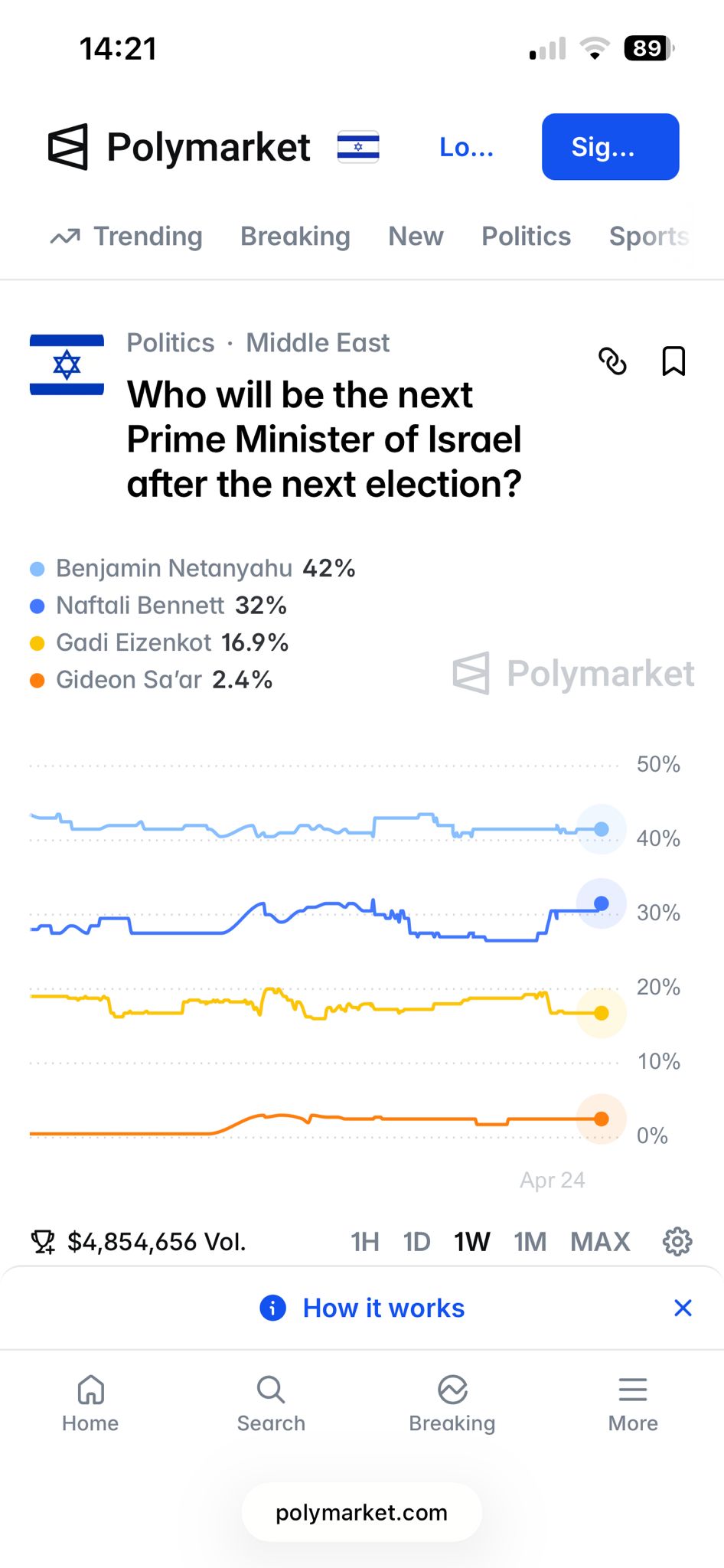
Issue Trends
Core takeaways: Netanyahu remains blocked in most polls and Bennett the clear opposition favorite.
While Netanyahu leads all head-to-head matchups, he is within the margin of error against Bennett (40–37), who remains competitive. At the same time, large pools of undecided voters signal continued volatility, particularly voters considering Gadi Eisenkot, whose potential support appears broad but shallow. Bennett is also the clear favorite to lead the non-Netanyahu Bloc, 37% to 28% for Eisenkot in the multi candidate poll and 51%-35% in the head-to-head matchup.
Public opinion remains sharply polarized:
Torch lighting ceremony: ~45% view it as political vs ~31% statesmanlike
Inquiry committee: 60% favor a state commission vs 23% a government-appointed one
Across both issues, there is a clear divide between coalition and opposition voters.
Bloc Trends & Eyes on the Threshold
The dominant structural factor remains the ~6–8% wasted vote from parties below the threshold, enough to materially shift bloc outcomes.
For the Netanyahu bloc: The central vulnerability is Bezalel Smotrich running alone, failing to pass the threshold in most polls outside Filber, Additional risks include potential independent runs by Avi Maoz (Noam) and a new party led by Ofer Winter.
For the Bennett bloc: Vote leakage to Benny Gantz and Yoaz Hendel, both consistently below threshold.
For the Arab bloc: Fragmentation risk if Sami Abu Shehadeh leads Balad in an independent run.
Threshold dynamics alone explain much of the gap between polls, particularly the divergence seen in Filber where Smotrich consistently passes and the others do not.
What to Watch Next
We are roughly six months out from the election, and the system remains structurally locked: Bennett bloc ~60 and the Netanyahu bloc short of 61 in most polls.
Key upcoming trigger point: The Knesset returns from recess on May 11 From there, two scenarios:
Status quo timeline: Knesset session runs through late July → election recess → 27 October election.
Early election scenario: Government falls in May → election window between August 11 – September 1.
Bottom Line: The map has not fundamentally shifted with Netanyahu still blocked and Bennett consolidating the support within his camp.
| Poll | Publisher | Pollster | Date | Sample | Margin of Error |
|---|---|---|---|---|---|
| 1 | Maariv | Lazar | April 23, 2026 | 502 | ±4.4% |
| 2 | Channel 12 | Midgam | April 23, 2026 | 502 | ±4.4% |
| 3 | Channel 14 | Filber | April 23, 2026 | 958 | N/A |
| Party | Maariv/Lazar | Channel 12/Midgam | Channel 14/Filber |
|---|---|---|---|
| Likud (Netanyahu) | 24 | 25 | 35 |
| Bennett 2026 (Bennett) | 24 | 21 | 10 |
| Yashar (Eisenkot) | 12 | 14 | 12 |
| Democrats (Golan) | 9 | 10 | 8 |
| Yisrael Beteinu (Lieberman) | 9 | 8 | 9 |
| Yesh Atid (Lapid) | 7 | 7 | 4 |
| Shas (Deri) | 9 | 9 | 11 |
| UTJ | 7 | 7 | 8 |
| Otzma Yehudit (Ben Gvir) | 9 | 9 | 8 |
| Religious Zionist Party (Smotrich) | 2.8% | 2.7% | 4 |
| Joint List (Arab Bloc) | — | — | 11 |
| Hadash-Ta’al (Arab Bloc) | 5 | 5 | — |
| Ra’an (Arab Bloc) | 5 | 5 | — |
| Balad (Arab Bloc) | 1.4% | 0.4% | — |
| Reservists (Hendel) | 2% | 1.3% | — |
| Blue & White (Gantz) | 1.7% | 0.8% | 1.2% |
| Bloc | Maariv/Lazar | Channel 12/Midgam | Channel 14/Filber |
|---|---|---|---|
| Netanyahu Bloc | 49 | 50 | 66 |
| Bennett Bloc | 61 | 60 | 43 |
| Arab Bloc | 10 | 10 | 11 |
Additional Polls: All polls from Midgam unless specifically written
| Matchup | Netanyahu | Opponent | Don’t Know |
|---|---|---|---|
| vs Bennett | 40% | 37% | 23% |
| vs Eisenkot | 40% | 35% | 25% |
| vs Lapid | 44% | 24% | 32% |
| vs Lieberman | 42% | 19% | 39% |
| Candidate to Lead the Non-Netanyahu Bloc | % |
|---|---|
| Bennett | 37% |
| Eisenkot | 29% |
| Lapid | 12% |
| Lieberman | 8% |
| Golan | 6% |
| Don’t Know | 8% |
| Bennett vs Eisenkot (Among Bloc Voters) | % |
|---|---|
| Bennett | 51% |
| Eisenkot | 35% |
| Don’t Know | 14% |
| Commission of Inquiry Preference | General Public | Coalition Voters | Opposition Voters |
|---|---|---|---|
| State Commission (appointed by Supreme Court President) | 60% | 22% | 89% |
| Government Commission (appointed by Netanyahu) | 23% | 54% | 5% |
| Don’t Know | 17% | 25% | 6% |
| Group | Political | Statesmanlike | Don’t Know |
|---|---|---|---|
| Maariv Poll (General Public) | 44% | 32% | 24% |
| Midgam (General Public) | 45% | 31% | 24% |
| Coalition Voters | 11% | 59% | 30% |
| Opposition Voters | 71% | 14% | 15% |