
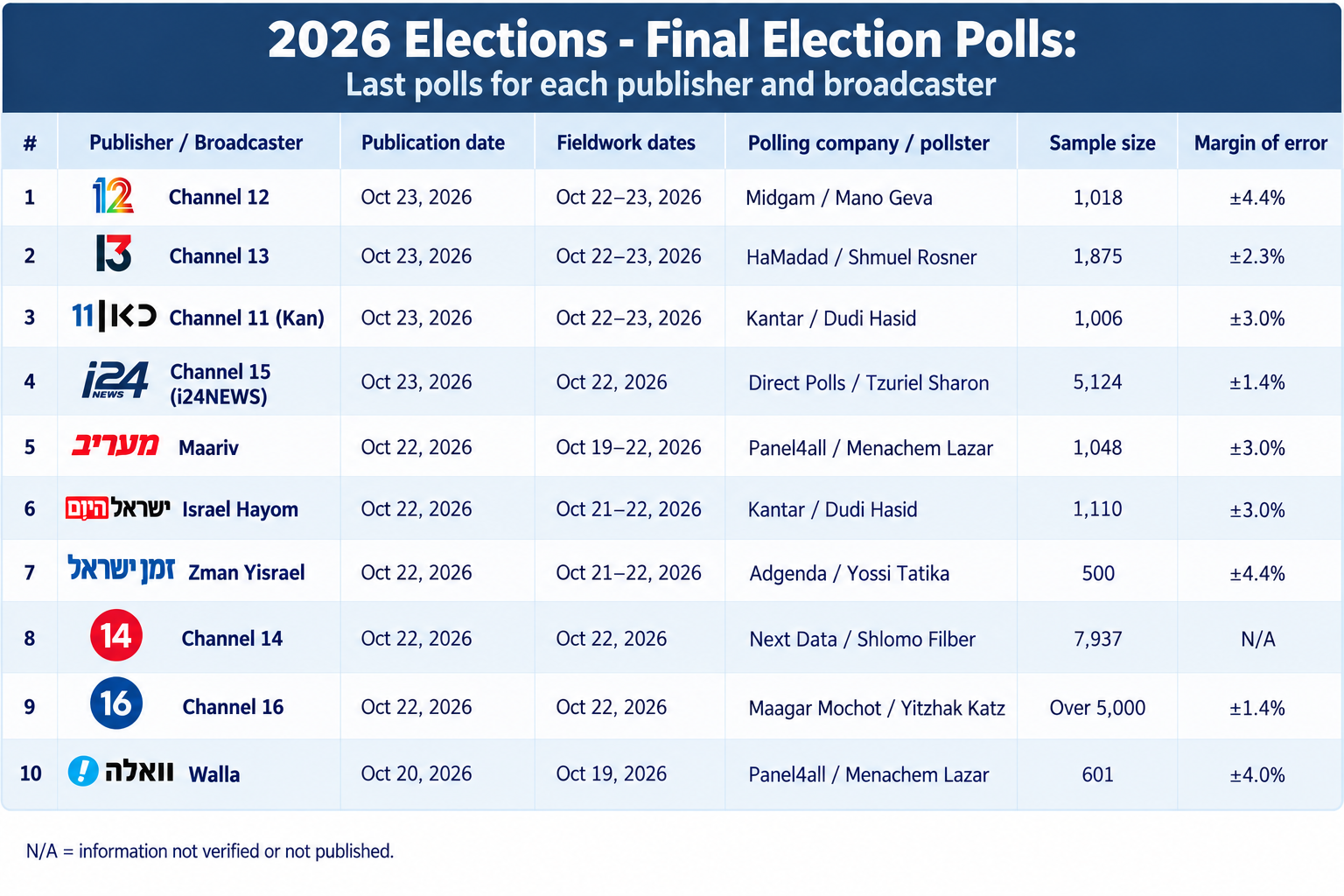
The final ten election polls are in, published by six major television stations and four newspapers, and conducted by eight polling companies.
The first tier consists of three parties consistently polling in double digits across all ten surveys. Likud is the largest party in just two polls, while Eisenkot’s Yashar leads comfortably in the other eight. Bennett’s B’Yachad finishes third in all ten.
The second tier consists of seven parties polling within a relatively narrow range, generally within two seats of one another, with Ra’am polling slightly below the rest.
The third tier consists of Hendel’s Party, which fails to cross the electoral threshold in four of the ten polls, and Winter’s Party, which crosses the threshold in just two.
More than 20 additional parties are running but fail to cross the electoral threshold in any of the ten polls, including Noam and The Haredi Public. Historically, parties polling at just above the electoral threshold have sometimes fallen below it on Election Day, while surprise victories by parties consistently polling below the threshold have been less common.
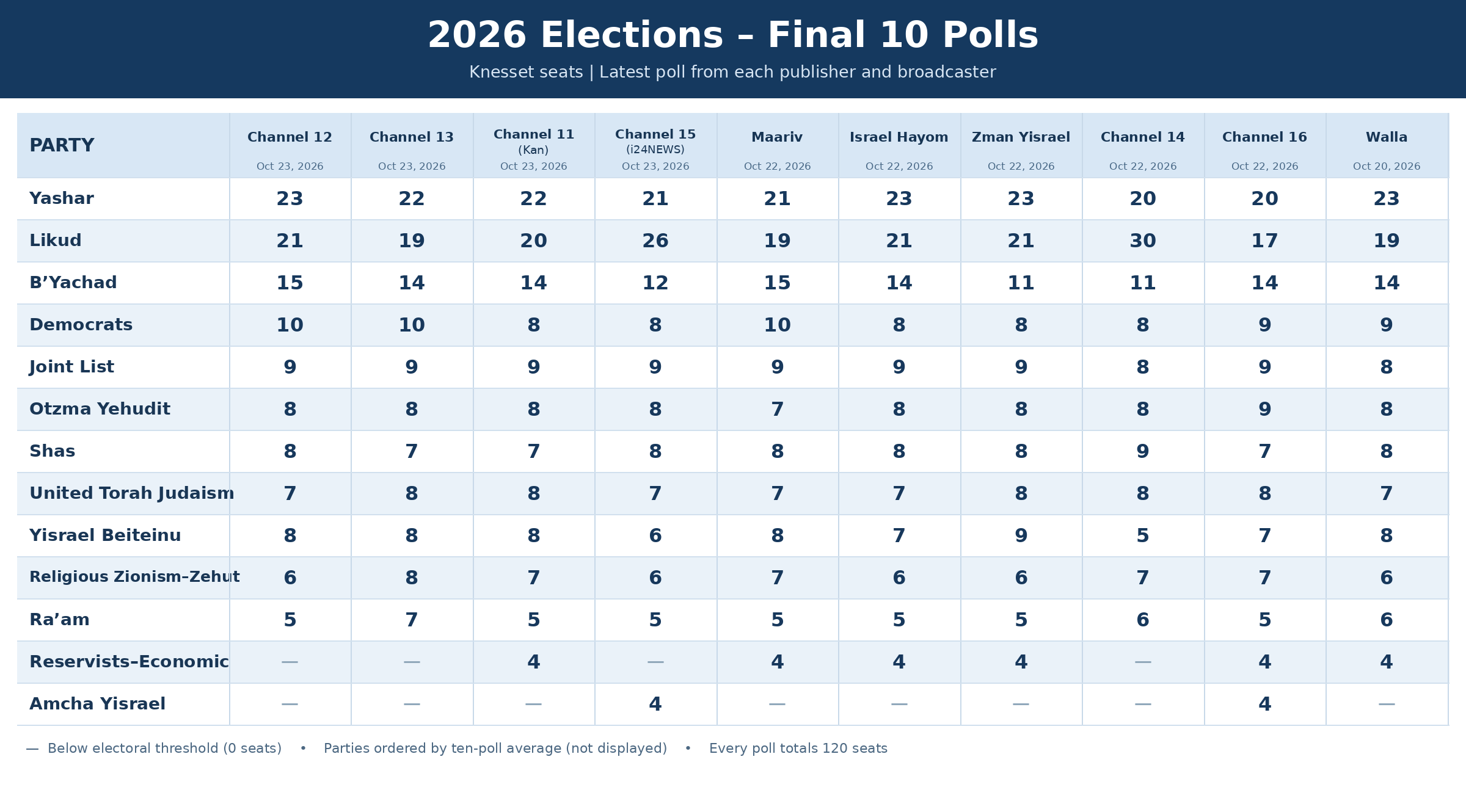
Here’s the breakdown of the results from each of the ten final polls:
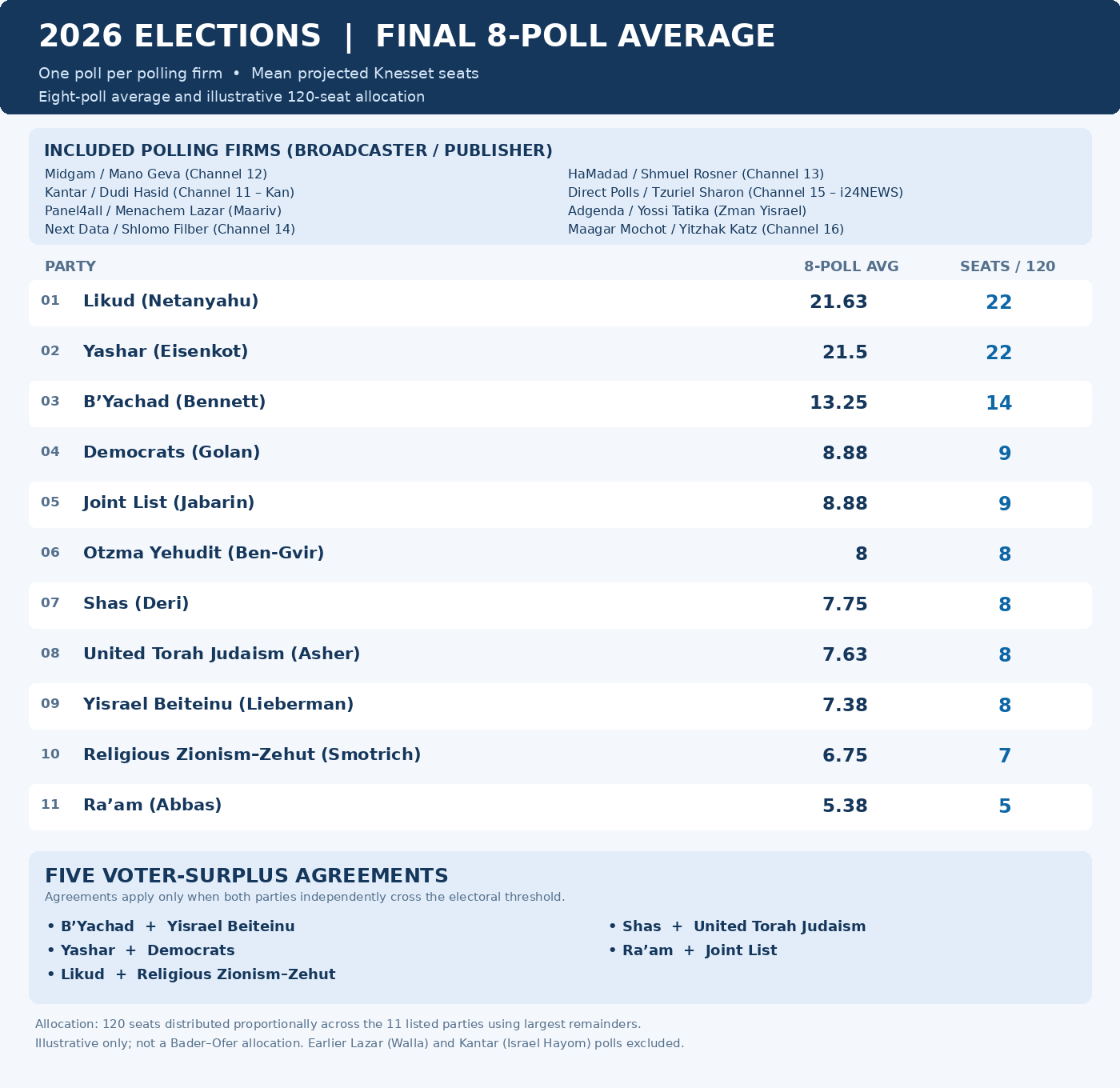
In previous election years, I published my own KnessetJeremyAvg. This year, I’m simply publishing an eight-poll arithmetic mean, based on the latest poll from each polling company.
Such averages have their limitations, as they give outlier polls the same weight as polls conducted by more accurate pollsters.
I’ve also included the five voter-surplus agreements at the bottom to provide additional context for potential seat-allocation changes under the Bader–Ofer method.
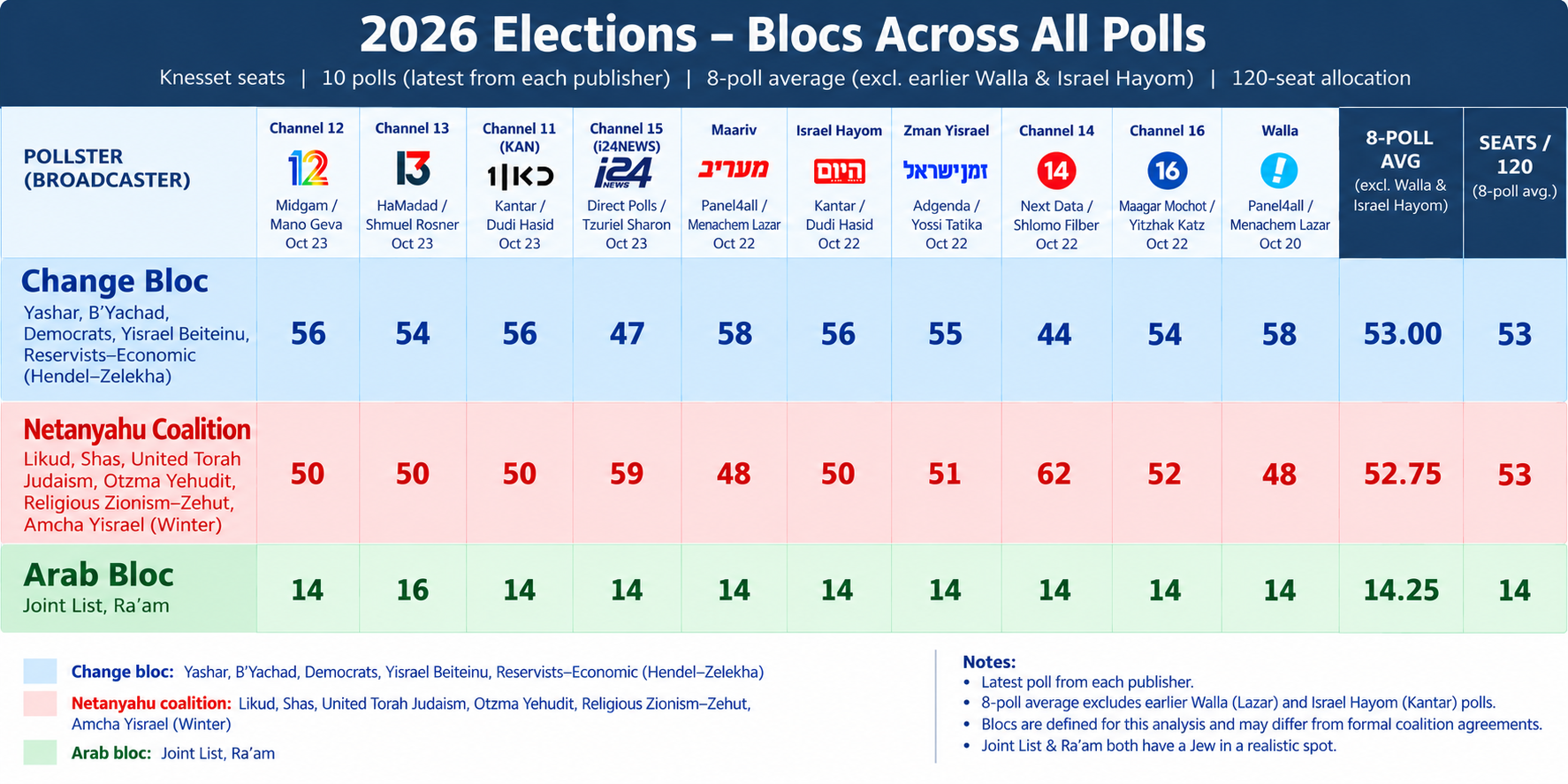
Lastly, we have the blocs. The Change Bloc polls between 54 and 56 seats in six surveys, reaching a high of 58 in both Lazar polls and falling to lows of 44 with Filber and 47 with Sharon.
The Netanyahu coalition reaches 62 seats with Filber and 59 with Sharon, but polls considerably lower, between 48 and 52 seats, in the other eight surveys.
The Arab Bloc receives 14 seats in nine of the ten polls, with Rosner’s survey being the sole exception, projecting 16 seats.
The bottom line: After the first Knesset to complete a full four-year term since 1984–1988, and the first full term without a change of prime minister since 1969–1973, all eyes are on how Israelis will vote this Tuesday.
At 10 PM Israel time, we will get the exit polls. However, these polls do not directly sample voters casting ballots using the double-envelope system, meaning we may not have results approaching the final count until Thursday at 9 PM.
Estimates suggest that between 600,000 and 650,000 voters could cast double-envelope ballots, potentially accounting for the equivalent of 15–16 Knesset seats.
Those eligible include: IDF soldiers, police officers, prisoners and detainees, Israel Prison Service personnel, hospitalized patients, hospital medical personnel, people with mobility disabilities, residents of institutions for people with mobility disabilities, nursing home and assisted-living residents, Israeli diplomats and official state representatives abroad, employees of designated national institutions abroad, eligible family members accompanying official representatives abroad, women residing in domestic violence shelters, sailors aboard qualifying Israeli vessels, Central Elections Committee members and employees, regional election committee members and employees, and polling-station officials and election workers.
Note: I hope my next post will be the exit polls.


